Linux starter pack
After Windows it is Linux's turn: Homylon now has a simple starter pack for Linux too! One download gives you the Engine, the agents for Philips Hue, MQTT and the power of your house, a simple monitor and a first house to start from. And it has homfigurator: one list to install, start and stop everything, so you do not have to know all the commands.
The pack runs on a PC or mini PC with Linux, and on a Raspberry Pi. There is one for each kind of machine:
PC or mini PC (intel64) Raspberry Pi 64-bit (arm64) Raspberry Pi 32-bit (arm32)
Windows Is Here !
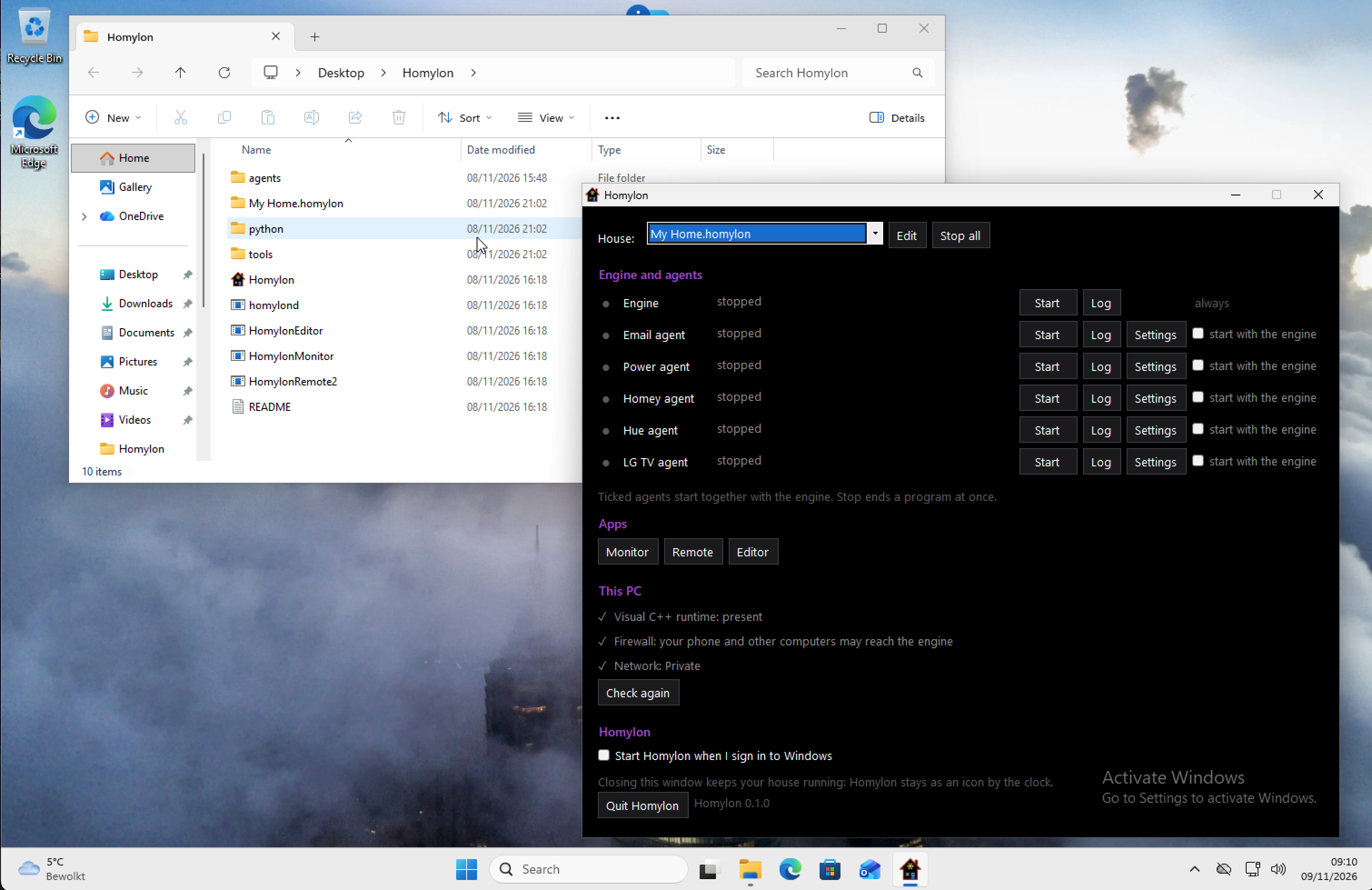
Homylon now runs on Windows! One download gives you the Engine, the apps and five agents. There is nothing to install: unzip it, double-click Homylon and your house is running.
The starter pack is for Windows 10 and 11 (64-bit). It holds a small house to begin with, examples of what you can do, and the Python that some agents use, so you do not need to install that either.
Meet the Jensens
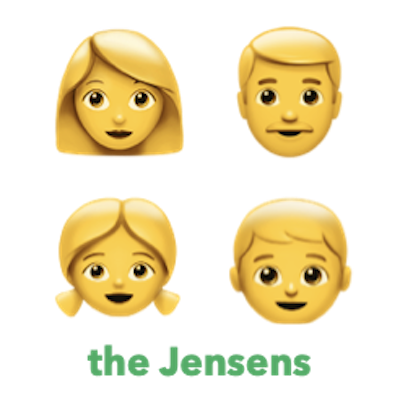
Mark, who cannot hear the doorbell but never misses a visitor. Sophie, who wants one message when the house is empty, not forty. Daan, who has never switched off a light in his life. And Emma, the family nerd, who taught twenty years of mismatched gadgets, an old Mac and a Raspberry Pi to speak one language.
A family with a home treated like a family member: it knows their habits, keeps their secrets and answers to them alone. No cloud. No subscription. No brand in charge.
What the Jensens wanted was not another app. They wanted a house that behaves the way this family lives: a porch light that greets a visitor, a doorbell that reaches Mark with light and a tap on his wrist, curtains that close at sunset, lamps that go out when the last one leaves. A house that knows their habits, keeps their secrets and answers to them alone. No cloud, no subscription, no brand in charge.
A Brief History of Home Automation
Over the last few decades home automation, or domotica, has become increasingly popular. People wanted more than a manually operated switch on the wall and technology vendors saw their opportunity. Soon they were competing with one another, overwhelming homeowners with new ideas, technologies, services and products.
Each came with its own promises, benefits and concerns. Unfortunately, comparing them was often confusing because they were not always addressing the same problems. Sometimes the innovation concerned a wireless communication protocol, sometimes the architecture, cloud services, hubs, apps, speech recognition, intelligence, transparency or interoperability. And then there were all the other fancy technologies vendors used to promote their products.
For homeowners, adopting new technology frequently meant abandoning some of what they already had and moving on to the next generation. Many vendors also tried to protect their products through proprietary technology, preventing devices from different manufacturers or generations from communicating with one another.
This article takes a brief look at some of these technologies, explaining their benefits and concerns.
Page 1 of 2